
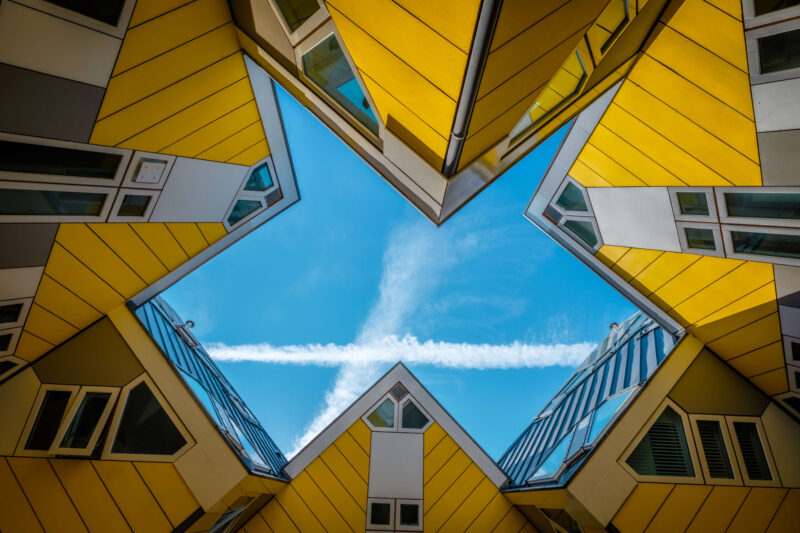
Rotterdam is the only major city in the Netherlands that was almost entirely rebuilt from scratch — and the result is one of Europe’s greatest open-air architecture museums. Bombed flat by the German Luftwaffe in May 1940, Rotterdam reinvented itself as a testing ground for architectural ambition, producing buildings that have won every major international prize and inspired architects worldwide. For cruise passengers with a few hours ashore from the Cruise Terminal Rotterdam, this self-guided walk covers the key architectural landmarks within a 2km radius of the city centre.
The Self-Guided Architecture Walk
Stop 1: Markthal (Dominee Jan Scharpstraat 298)
Start at the Markthal — designed by MVRDV architects and opened in 2014. The building is a 40m-high horseshoe arch that houses both a covered food market at ground level and 228 apartments in the arching structure above. The ceiling — 11,000m² of artwork by Arno Coenen called “Horn of Plenty” — is one of the largest artworks in the world. Entry is free; the market stalls serve breakfast and brunch.
Stop 2: Cube Houses (Overblaak 70)
Immediately adjacent to the Markthal are the Kubuswoningen — 38 cube-shaped houses tilted at 45 degrees, designed by Piet Blom in 1984. They were conceived as an “urban forest” — each cube representing a tree. The yellow cubes are private residences; the Kijk-Kubus show house is open to visitors for €3 and gives a fascinating glimpse of living in a tilted cube.
Stop 3: Blaaktoren — The Pencil
Next to the Cube Houses stands the Blaaktoren — nicknamed “the Pencil” for its cylindrical form with a pointed top. Also designed by Piet Blom, it’s actually a conventional apartment building despite its extraordinary appearance. The combination of Markthal, Cube Houses, and Blaaktoren in one frame makes for one of Rotterdam’s most photographed views.
Stop 4: Erasmus Bridge (Erasmusbrug)
Walk south on Willemsplein to reach the Erasmusbrug — Ben van Berkel’s magnificent 284m cable-stayed bridge, opened in 1996 and nicknamed “the swan” for its elegant asymmetric pylon. Cross the bridge on foot (it takes about 10 minutes) for the best views of the Maas waterfront and the port skyline. The south bank of the bridge offers a panoramic view that photographers dream of.
Stop 5: De Rotterdam (Wilhelminakade 139)
On the south bank of the Erasmus Bridge stands De Rotterdam — a 162m-high “vertical city” designed by Rem Koolhaas / OMA and completed in 2013. Three interconnected towers contain offices, apartments, a hotel, and restaurants. The building looks different from every angle; photographed from the north bank of the Maas (near the Water Taxi stop), it frames magnificently with the bridge.
Stop 6: Hotel New York (Wilhelminakade 1)
A 10-minute walk along the south bank brings you to Hotel New York — the Art Nouveau former headquarters of the Holland America Line, built in 1901. This building has profound resonance for cruise passengers: it was from this very pier that the ships departed for New York, carrying millions of emigrants to a new world. Stop for a coffee or lunch at the celebrated hotel restaurant before taking the Water Taxi back to the terminal.
See our full dining guide: Where to Eat Near Rotterdam Cruise Port.
Booking Architecture Tours
Prefer a guided experience? Several excellent Rotterdam architecture tours are available on GetYourGuide — including walking tours, cycling tours, and boat tours that see the architecture from the river. Booking in advance is recommended for small-group tours in peak season.
Frequently Asked Questions
How long does the Rotterdam architecture walk take?
The walk described above takes approximately 2.5–3 hours at a comfortable pace, including time inside the Markthal, the Kijk-Kubus show house, and crossing the Erasmus Bridge. Allow additional time for photography stops and a coffee break.
Is Rotterdam’s architecture suitable for non-architecture enthusiasts?
Absolutely — Rotterdam’s architectural landmarks are visually spectacular and accessible to anyone. You don’t need architectural knowledge to appreciate the Cube Houses, the Markthal ceiling, or the view from the Erasmus Bridge. It’s one of the most photogenic city walks in the Netherlands.